Last reviewed: March 2026
Contents
MDM Templates
Hyponatremia — Mild/Asymptomatic
Patient found to have sodium *** mEq/L. Alert and oriented with no neurologic deficits, no seizure activity, no altered mental status. History, exam, and workup reassure against acute symptomatic hyponatremia requiring emergent correction.
The risk of osmotic demyelination from rapid correction outweighs the risk of mild hypoosmolality in this patient. The priority is identification of the underlying cause — this requires additional testing best done in the inpatient setting where sodium can be monitored serially.
Plan: Admit for continuous monitoring and targeted workup. Start fluid restriction if SIADH suspected or 0.9% NS if clinically hypovolemic. Target correction rate 4–8 mEq/L over 24 hours. Hold medications that worsen hyponatremia (SSRIs, carbamazepine, NSAIDs, HCTZ, desmopressin). Repeat sodium in 4–6 hours.
Disposition: Admit to medicine with nephrology consultation if etiology unclear.
Hyponatremia — Severe/Symptomatic
Patient presents with sodium *** mEq/L and neurologic symptoms (altered mental status / seizure / confusion). This is a medical emergency reflecting cerebral edema from hypoosmolality.
Plan: 3% sodium chloride 100–150 mL IV bolus over 10–20 minutes. DDAVP 1–2 mcg IV given concurrently to prevent overcorrection via the DDAVP clamp strategy. Goal is to raise sodium by 4–6 mEq/L acutely to stop seizure activity. If seizures persist, may repeat 3% bolus up to two additional times. Target correction no more than 8 mEq/L in the first 24 hours.
If overcorrecting (sodium rising >8 mEq/L in 24h): Stop hypertonic saline, give DDAVP 2 mcg IV, consider D5W to re-lower sodium.
Disposition: ICU admission. Nephrology and neurology consulted. Serial sodium checks every 2–4 hours.
Hypernatremia — Mild (Na 146–155)
Patient presents with sodium *** mEq/L. Alert and neurologically intact. History and exam suggest free water deficit from *** (insensible losses / inadequate intake / diabetes insipidus). Calculated free water deficit is *** L.
Plan: Admit for monitoring and slow correction. Hypotonic fluids (D5W or 0.45% NS) to replace calculated deficit over 24–48 hours. Target correction rate 0.5 mEq/L/hr, maximum 10–12 mEq/L per 24 hours. NS is not appropriate unless hemodynamically unstable. Recheck sodium every 6–12 hours.
Disposition: Admit to medicine.
Hypernatremia — Severe (Na >155)
Patient presents with sodium *** mEq/L and altered mental status. Severe cellular dehydration with neurologic symptoms reflecting brain cell shrinkage. Mortality is high if untreated.
Plan: ICU admission. Calculated free water deficit *** L. D5W infusion started to correct at 0.5 mEq/L/hr maximum, not exceeding 10 mEq/L per 24 hours. Workup for etiology including urine osmolality, desmopressin challenge if DI suspected.
Disposition: ICU. Nephrology consulted.
Clinical Education
Hyponatremia by Volume Status
Clinical volume assessment drives the approach.[9] Serum osmolality, urine osmolality, and urinary sodium direct the workup.
| Volume Status | Mechanism | Diagnosis | Initial Treatment |
| Hypovolemic | GI losses, diuretics, renal losses | Urine Na <10, FENa <0.5% | 0.9% NS; correct slowly to avoid overcorrection |
| Euvolemic | SIADH, hypothyroidism, adrenal insufficiency | Urine Na >40, urine osm >100 | Fluid restriction (500–800 mL/day) |
| Hypervolemic | CHF, cirrhosis, nephrotic syndrome | Urine Na <10, low albumin | Fluid restriction, treat underlying disease |
Diagnostic workup:[5] Serum osmolality, urine osmolality, urine sodium, thyroid function, cortisol.
SIADH Diagnosis & Pearls
SIADH is a diagnosis of exclusion in the euvolemic hyponatremic patient.[1] Diagnostic criteria: euvolemia, serum osm 100, urine Na >40, normal thyroid and cortisol, no diuretic use.
Common medication causes: SSRIs/SNRIs (especially sertraline, paroxetine, venlafaxine), carbamazepine/oxcarbazepine, desmopressin, NSAIDs, thiazide diuretics.
CNS and pulmonary causes: Head trauma, meningitis, SAH, small-cell lung cancer, pneumonia, positive-pressure ventilation.
Management: First-line is fluid restriction to 500–800 mL/day. Vaptans (tolvaptan) reserved for refractory cases. Discontinue offending medication.
Hypertonic Saline Protocol
3% NaCl is the definitive treatment for symptomatic hyponatremia.[2]
| Parameter | Details |
| Standard bolus | 3% NaCl 100–150 mL IV over 10–20 min |
| Repeat | May repeat x2 if seizures persist |
| Calculation | 1 mL/kg of 3% NaCl raises Na ~1 mEq/L |
| Target | Raise Na 4–6 mEq/L acutely |
| 24h max | Do not exceed 8 mEq/L in 24 hours |
Use the MDCalc Sodium Correction Rate calculator.
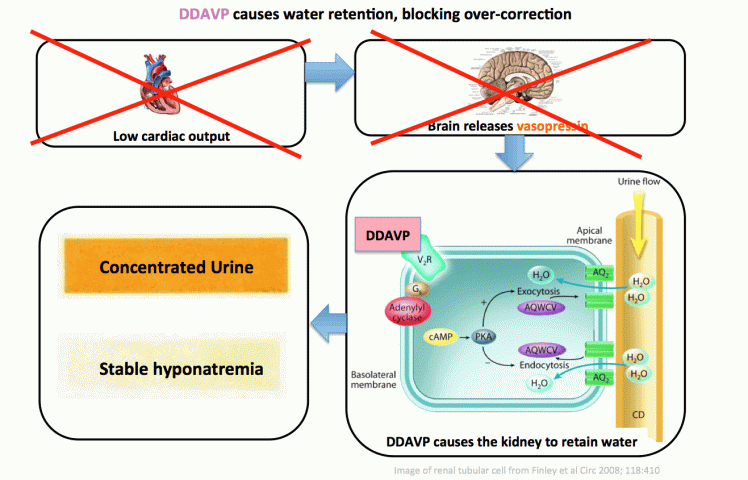
DDAVP Clamp Strategy
The problem: Dehydrated patients given NS rapidly regain volume. Once restored, kidneys dump free water and sodium climbs steeply, risking demyelination. DDAVP blocks this.[3]
Dosing: DDAVP 1–2 mcg IV push or 4 mcg SC, repeat q6–8h. Give with or immediately after 3% saline. In hypovolemic patients, give early — do not wait to see if overcorrection happens.
Monitoring: Sodium every 2–4 hours. If rising faster than 6 mEq/L/day, redose DDAVP.
Osmotic Demyelination Syndrome
Risk factors:[4] Chronic hyponatremia (>48h) corrected too rapidly, alcoholism, liver disease, malnutrition, hypokalemia, elderly.
Pathophysiology: Rapid increase in osmolality causes water to flow out of brain cells faster than osmolytes can be excreted. Myelin sheaths dehydrate and crack.
Presentation (2–6 days after overcorrection): Locked-in syndrome, dysarthria, ataxia, tremor, coma. MRI shows T2 hyperintensity in pons.
Prevention: Limit correction to 4–6 mEq/L in first 6 hours, 8 mEq/L in 24 hours. DDAVP prophylactically in high-risk patients.
If overcorrecting: Stop hypertonic saline, DDAVP 2 mcg IV, consider D5W to re-lower sodium. No cure once ODS develops.
Hypernatremia Pearls
Almost always a free water problem.[10] Calculate the free water deficit:
Free Water Deficit = TBW × [(Current Na ÷ 140) − 1]
TBW ≈ 0.6 × weight (kg) men, 0.5 × weight (kg) women
Use the MDCalc Free Water Deficit calculator.
Correction rate: 0.5 mEq/L/hr max, 10–12 mEq/L per 24 hours.
| Fluid | When to Use |
| D5W | Preferred. Pure free water once glucose metabolized. |
| 0.45% NS | Acceptable alternative. Less effective per volume. |
| 0.9% NS | Only if hypovolemic. NS is hypertonic relative to goal. |
Medication Causes
Many common medications cause sodium disorders.[7]
| Medication | Mechanism | Effect |
| SSRIs | SIADH | Hyponatremia |
| Carbamazepine | SIADH | Hyponatremia |
| Thiazides (HCTZ) | Volume depletion + ADH | Hyponatremia |
| NSAIDs | Enhanced ADH effect | Hyponatremia |
| Loop diuretics | Free water loss | Hypernatremia |
| Lithium | Nephrogenic DI | Hypernatremia |
| Mannitol | Osmotic diuresis | Hypernatremia |
References
- Verbalis JG, Goldsmith SR, Greenberg A, et al. Hyponatremia treatment guidelines 2007. J Clin Endocrinol Metab. 2007;92(8 Suppl):s3S–s9S. PubMed
- Sterns RH. Disorders of plasma sodium. N Engl J Med. 2015;372(1):55–65. PubMed
- Sterns RH, Silver SM. Cerebral edema and osmotic demyelination syndrome. Kidney Int. 2008;74(11):1379. PubMed
- Sterns RH, Riggs JE, Schochet SS. Osmotic demyelination syndrome following correction of hyponatremia. N Engl J Med. 1986;314(24):1535–1542. PubMed
- Spasovski G, Vanholder R, Allolio B, et al. ERA-EDTA Guideline on Hyponatremia. Nephrol Dial Transplant. 2014;29(Suppl 2):i1–i39. PubMed
- Mohmand HK, Issa D, Ahmad Z, et al. Hypertonic saline for hyponatremia: risk of overcorrection. Clin J Am Soc Nephrol. 2007;2(6):1110–1117. PubMed
- Sonnenblick M, Friedlander Y, Rosin AJ. Thiazide-induced hyponatraemia. Ann Intern Med. 1993;118(1):24–27. PubMed
- Cuesta M, Saborio P, Hew-Butler T. Hyponatraemia: consensus and emerging aspects. Lancet Diabetes Endocrinol. 2021;9(6):413–422. PubMed
- Hoorn EJ, Zietse R. Diagnosis and treatment of hyponatremia. J Am Soc Nephrol. 2017;28(5):1340–1349. PubMed
- Adrogué HJ, Madias NE. Hypernatremia. N Engl J Med. 2000;342(20):1493–1499. PubMed
 tydotphrase.com